Bond ladders
A bond ladder is a set of gilts chosen so that their payments arrive when you need the money. This page explains the ladder builder. The figures it shows for each gilt are explained in gilts and index-linked gilts.
The bond ladder
A bond ladder is a set of gilts that mature one after another, so that their coupons and repayments arrive when you need the money. A typical use is income for a set number of years, with one or more gilts maturing each year.
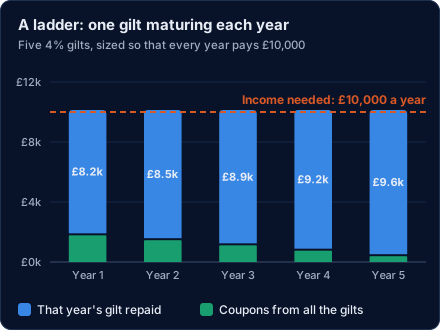
In the picture, each year's gilt is a little larger than the one before. The early years also collect coupons from every gilt still waiting to mature, so they need less from their own repayment.
The ladder builder can design one for you. Give it an income target, or a lump sum to invest, and it searches the gilts currently available for the cheapest set that covers each year. If a year's payments arrive early, the surplus is carried forward to the next need.
In Alfolio:
- Money carried forward, and any cash reserve, earns 0%. A real cash account would pay something, so the figures are slightly cautious.
- Each year's target is counted in whole 12-month periods. Gilts pay on fixed dates, so some months always receive more than others.
- Only UK gilts are included. Corporate bonds and foreign government bonds are not.
- Prices are mid-market and no dealing costs are included. See cost.
"Inflation-protected" income in the ladder designer
Choosing an inflation-protected income asks the designer for an income that rises each year by your RPI assumption, so that it keeps its buying power if inflation matches the assumption. It does not by itself buy index-linked gilts.
The designer meets the rising target as cheaply as it can at your RPI assumption, and that can mean buying conventional gilts. Conventional gilts pay fixed pounds, so if inflation runs higher than you assumed, their income falls behind.
To get real protection, require a share of linkers using the conventional / inflation-linked mix. The backtest tab shows what happened in past periods when inflation differed from the assumption.
Conventional / inflation-linked mix
This control decides how much of the ladder's income comes from index-linked gilts. Auto buys whatever is best value at your RPI assumption. Custom sets the share of each year's income that should come from linkers.
With Auto, the choice between conventionals and linkers rests entirely on your RPI assumption. A higher assumption makes linkers look better value, and a lower one favours conventionals. Auto does not give you protection against inflation turning out higher than you assumed.
With a custom mix, each year aims for your chosen share. Some years have no suitable linker maturing, so in those years the designer gets as close as it can rather than giving up. The summary card shows the share it achieved.
Cash reserve
When no gilt pays out early enough to cover a need, for example income due within the first year, the designer sets aside cash for it. That cash earns nothing in the projections.
The designer uses cash only where gilts cannot do the job, because any gilt earns more than 0%. A cash reserve in your design is a sign of a gap in the gilts available, usually near the start.
Backtest
The backtest asks: "If I had used these same settings on a past date, would the plan have worked?" It designs a ladder using only the gilts and prices available on that date, then follows it to today using the coupons, repayments and inflation that actually happened.
It tests your settings, not the particular gilts in your current ladder. Gilts available then were different from those available now.
Index-linked ladders can fall short in some periods even when their total income meets the target. Actual inflation does not rise in the smooth steady line the design assumed, so money can arrive later than it is needed. Conventional gilts pay exactly what they promise, but they lose buying power if inflation ran hotter than assumed. The Nominal £ / Today's money switch shows both views.
Last updated 2026-10-05.