Money in and goal shares
Goals do not have accounts of their own: they share yours. This page explains how money arriving and leaving is assigned to goals.
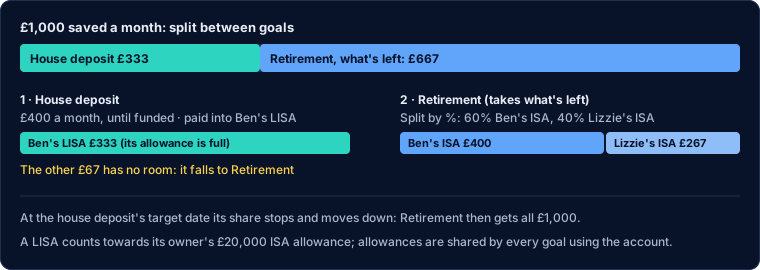
Money in
Money in says how much the plan saves, how that is split between goals, and how each goal's part is split between the accounts it is paid into. It is set on one page and each goal's Money in bar on the timeline is a view of it.
Between goals the split is by fixed amounts or by %, one unit for every goal (a % is a % of all of the saving). Goals are paid in order: if less arrives, the lower goals get less. Once there are two goals or more, the last can take what's left instead of an amount. A goal's share can run until funded: at its target date it stops and moves down to the goal taking what's left, so that goal's bar steps up.
Within a goal you tick the accounts it is paid into, in order, and split it by % (adding up to 100%) or by fixed amounts (the last account can take the rest). Each account has a slider and a box: the slider stops at what the accounts above it leave of the goal and at what is left of the account's allowance, so the amounts never add up to more than the goal or more than fits. Its far end is exactly what fits, so an allowance can be filled to the pound. An account at £0 or 0% only catches overflow. Amounts entered a week, month or quarter also show what they come to in a year, to compare with the yearly allowances.
Spread evenly across accounts shares the goal equally between its ticked accounts, each up to what is left of its allowance; what a full account cannot take is shared by the others. Accounts sharing one allowance (a person's ISA and LISA) each get a part of it. It keeps the goal's % or fixed split, except that a goal whose amount changes over time becomes a % split.
Allowances. An account can still fill up later: a % of a saving that grows, or a goal above using more of a shared allowance (a LISA's £4,000 also counts towards its owner's £20,000 ISA allowance). Then the extra goes to the next account down the goal's list, whoever owns it, and to the accounts above it only when those below are full. The order is the priority: move an account up or down to change where overflow goes. What no account of a goal can take falls to the goal taking what's left.
The same split is used for the planned saving in projections and backtests. With no regular saving it applies to each deposit as it arrives. The plan lists anything unfinished (a goal with no accounts, a split that does not add up) as a problem until it is fixed.
Each goal's share of an account
A goal owns a share of each account's value, in pounds. The shares always add up to the account's value, and each moves with the account's return: if the account rises 5%, every goal's share in it rises 5%.
Deposits are credited to goals by the account's planned split: if Money in sends £333 a month of House deposit and nothing else to a LISA, every deposit into it is the house deposit's. Money above the plan is credited the same way. Withdrawals come from the goal they were for. Holdings, cash and capital gains stay with the account: a goal's share is a claim on value, not on particular funds. Shares are brought up to date after every broker sync and each morning.
The holding goal
Every pound in an account belongs to a goal, so each account has a holding goal for money nothing has placed yet. Alfolio sets it for you: the goal taking what's left if it uses the account, else the goal Money in pays most into it.
It holds the account's value when the plan starts, a deposit into an account no goal's Money in pays into, a withdrawal no goal's spending explains, and money a goal gives up when you move shares by hand. The deposits and withdrawals are listed on the Money in page under Waiting to be given to a goal: say which goal each was for, and the amount moves between the goals on the day it happened. It stays put when the account syncs again.
If a goal gets less than its share of a month's deposits (the money went into an account it is not paid into), the Money in page says it is short.
One-off spends
A one-off spend takes a sum from one goal on a date: a house deposit, a car, a wedding. It is a marker on the goal's lane; drag it, or set the date in its panel.
On its date (or the first daily check within a week of it, after a weekend or a holiday) the plan raises the sum from the accounts the goal may use, cash first, then sales, down the withdrawal order, and lists the sales on Today. It is paid once. A withdrawal you make from one of those accounts from a week before to three weeks after the date is counted against that goal. The projection takes it in its month on every path.
Last updated 2026-11-09.