Money in
The Money in section appears in the accumulation phase. It says how much new money arrives, how often, and whether a windfall is drip-fed in.
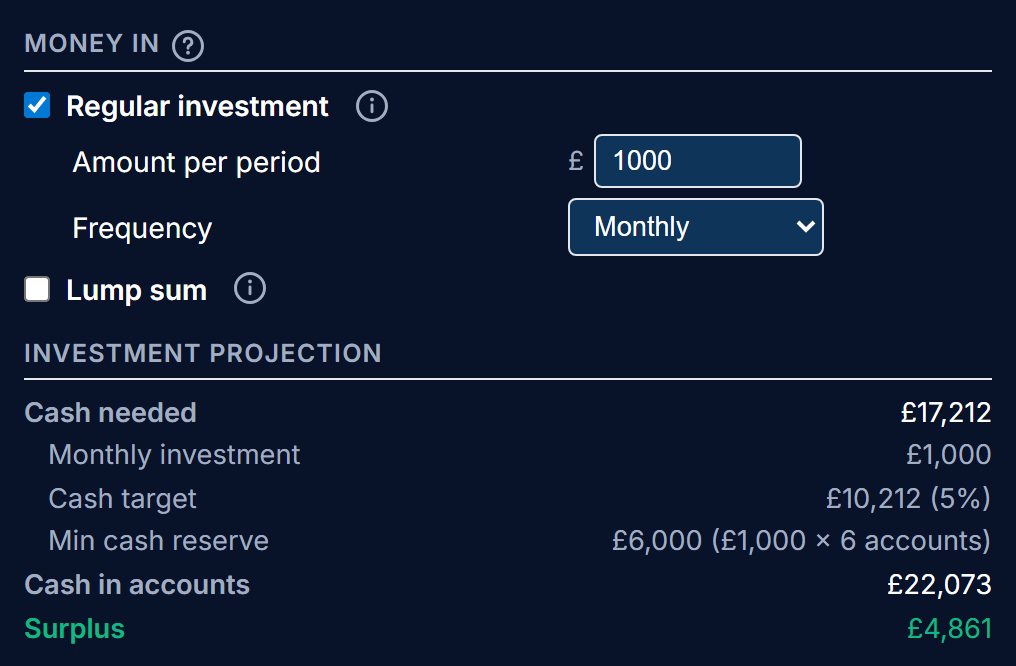
Regular investment
A fixed amount of new money each period, invested in the accounts in investing order, each up to its spare cash and its contribution allowance. Off means no scheduled amount; cash already in the accounts is still invested at each check.
Choose an amount and how often: weekly, fortnightly, monthly, quarterly or yearly. The investment is due once per calendar period (the month, the quarter, the tax year), counted from the last date you marked it executed. If no date is recorded, it is due now.
The money goes to the accounts in investing order: the first account takes as much as its contribution allowance allows, then the next. Each account can only invest the cash above its reserve; deposit the difference and the next check invests it.
Each deposit is invested into that account's holdings that are furthest below target, buying only. Nothing is sold to fund it.
Lump sum
Deploy a windfall or savings over time, a set instalment each period, until the whole amount is in. It can run alongside the regular investment and stops by itself when the total is deployed.
Enter the total, the amount per period and how often. The undeployed balance is tracked on the Investment Projection, and each instalment is invested like a regular investment, in investing order. Marking trades executed records the instalment as deployed.
Opportunistic acceleration
While the portfolio is further below its high than the trigger, each lump-sum instalment is multiplied, so more of the lump sum goes in when prices are down. The high is measured on a unitised basis: money arriving or leaving does not move it, only prices do.
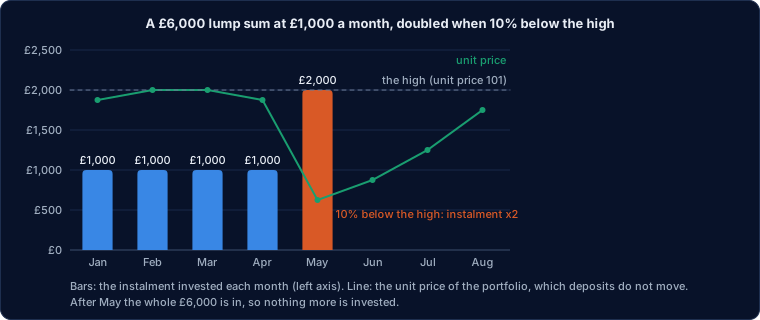
In the picture, a £6,000 lump sum goes in at £1,000 a month with a 10% trigger and a multiplier of 2. In May the funds are 10% below their high, so that month's instalment is £2,000, and the lump sum is fully deployed a month early. The total never exceeds the lump sum.
"Below its high" means the fall in the price of one unit of the portfolio, the same measure the performance pages use, so a large deposit does not create a new high and a withdrawal does not look like a fall.
Last updated 2026-10-10.