Cash
The Cash section appears in every phase. It has two amounts: a minimum in each account that strategy trades never touch, and the combined cash buffer, a target for how much cash the strategy holds.

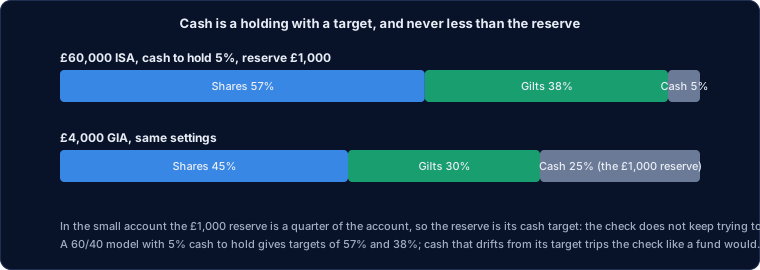
Cash is treated as a holding with a target of its own:
Minimum cash per account
An amount of cash kept in each account for fees and platform charges. A strategy trade never invests it and an income never withdraws it, in every phase.
Where the minimum is more than the combined cash buffer (a small account with a £1,000 reserve, say), the reserve is that account's cash target, so a check does not keep trying to invest it.
Combined cash buffer
Cash is a holding with this target. Cash above it is reinvested (monthly by default), and cash that drifts from it counts like a fund that drifts. In accumulation and maintenance it is a percentage of each account; in drawdown it is the income buffer, in periods of income or as a percentage of the portfolio.
The target cash is taken out of the model before the funds' targets are set, so a 5% cash buffer with a 60/40 model gives targets of 57% and 38% with 5% cash.
In drawdown, three periods of a £1,000 monthly income is a £3,000 buffer. The income sales top it up when it falls short, and it stays where they raise it: see where the income comes from. The page shows the equivalent in the other unit beside the setting.
Spare cash, above an account's minimum and its share of the buffer, is reinvested in every account, including a pension or Lifetime ISA that cannot be drawn from yet: it has years to grow before it can be taken out.
Reinvest cash above targets
On this schedule (monthly by default), each account's cash above its cash target is invested in its underweight holdings, buys only: dividends, coupons, bond redemptions and anything else that would otherwise sit as cash. It runs in every phase, even with the rebalance check off and while drift is below its threshold.
An account's cash target keeps:
- its minimum cash;
- its share of the combined cash buffer, at the level it holds now, or its cash to hold in accumulation and maintenance;
- in drawdown, the dividends held back for the next income in an account that can be drawn from (in every account when dividends count towards income from all accounts). They are reinvested after the income date only if the income did not use them.
Reinvesting runs on the last trading day of each week, month or quarter, or on the rebalance check's dates with "At each check". A day that rebalances does not also reinvest: the rebalance has already put the cash to work. Nothing is ever sold to reinvest. "Never" leaves spare cash until a rebalance.
Taking income from the buffer in a drawdown
While the portfolio's drawdown (its fall from its high) is more than the threshold, 15% by default, the income is taken from the cash buffer and nothing is sold; this lasts until the portfolio reaches a new high, and only then is the buffer rebuilt.
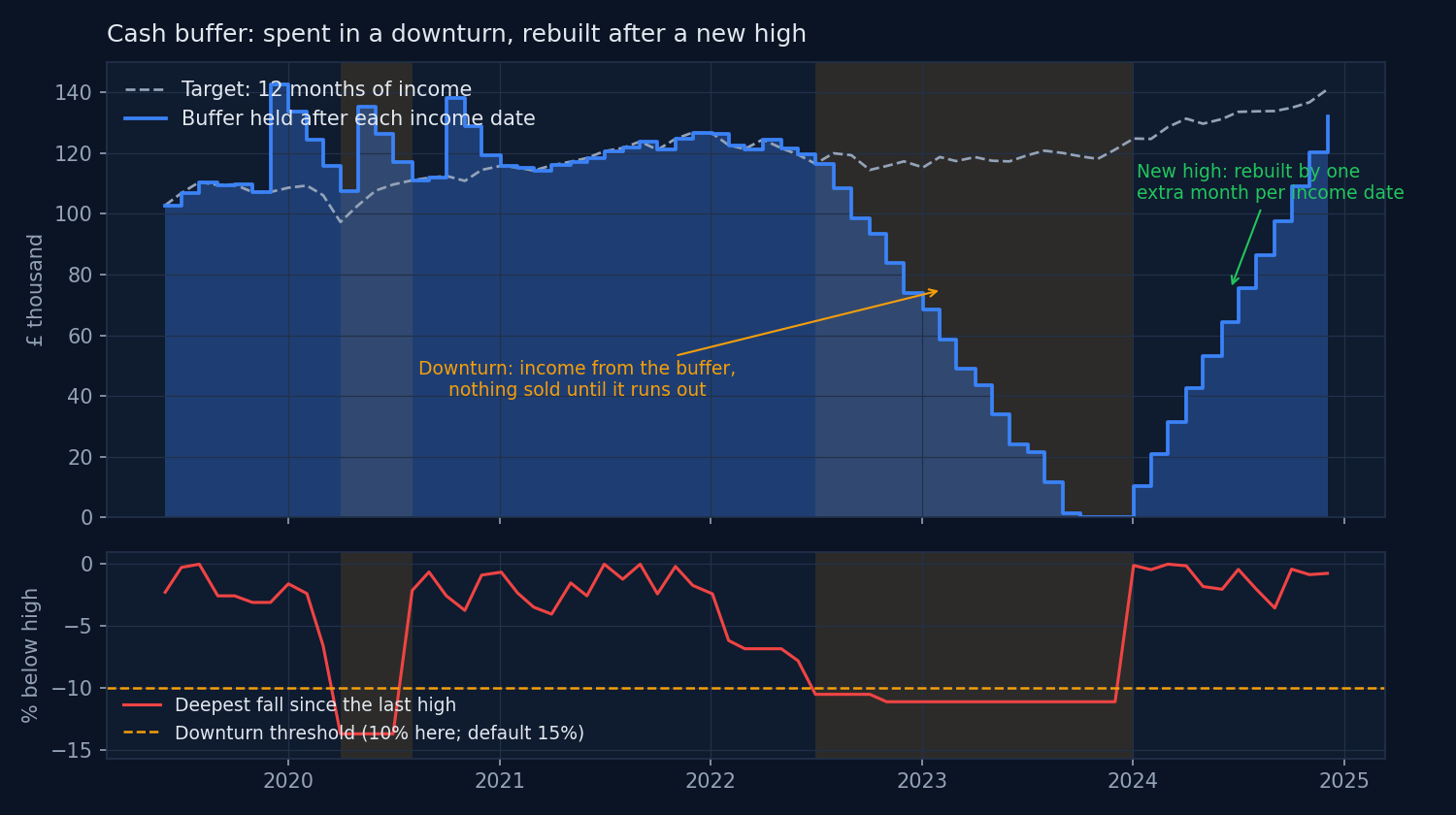
- The high is the portfolio's unitised value, so money paid in or taken out does not move it: drawing an income is not a fall.
- A downturn ends at a new high, not when the fall shrinks back under the threshold. Ending it at the same line would switch between spending and refilling every month while the portfolio hovers there.
- If the cash runs out before the new high, holdings are sold for each period's income, as without it.
This applies wherever the buffer is held: in the accounts the income sales come from, or in a buffer account. The aim is to avoid selling at low prices. The picture above uses a 10% threshold so the rule shows; that strategy's deepest fall since 2015 is 14%, so at 15% it would never have fired.
Rebuilding the buffer
After a drawdown beyond your threshold, rebuilding waits until the portfolio reaches a new unitised all-time high. At all other times the buffer is rebuilt over the number of income periods you set (12 by default): each income date sells at most the income plus the target divided by that number.
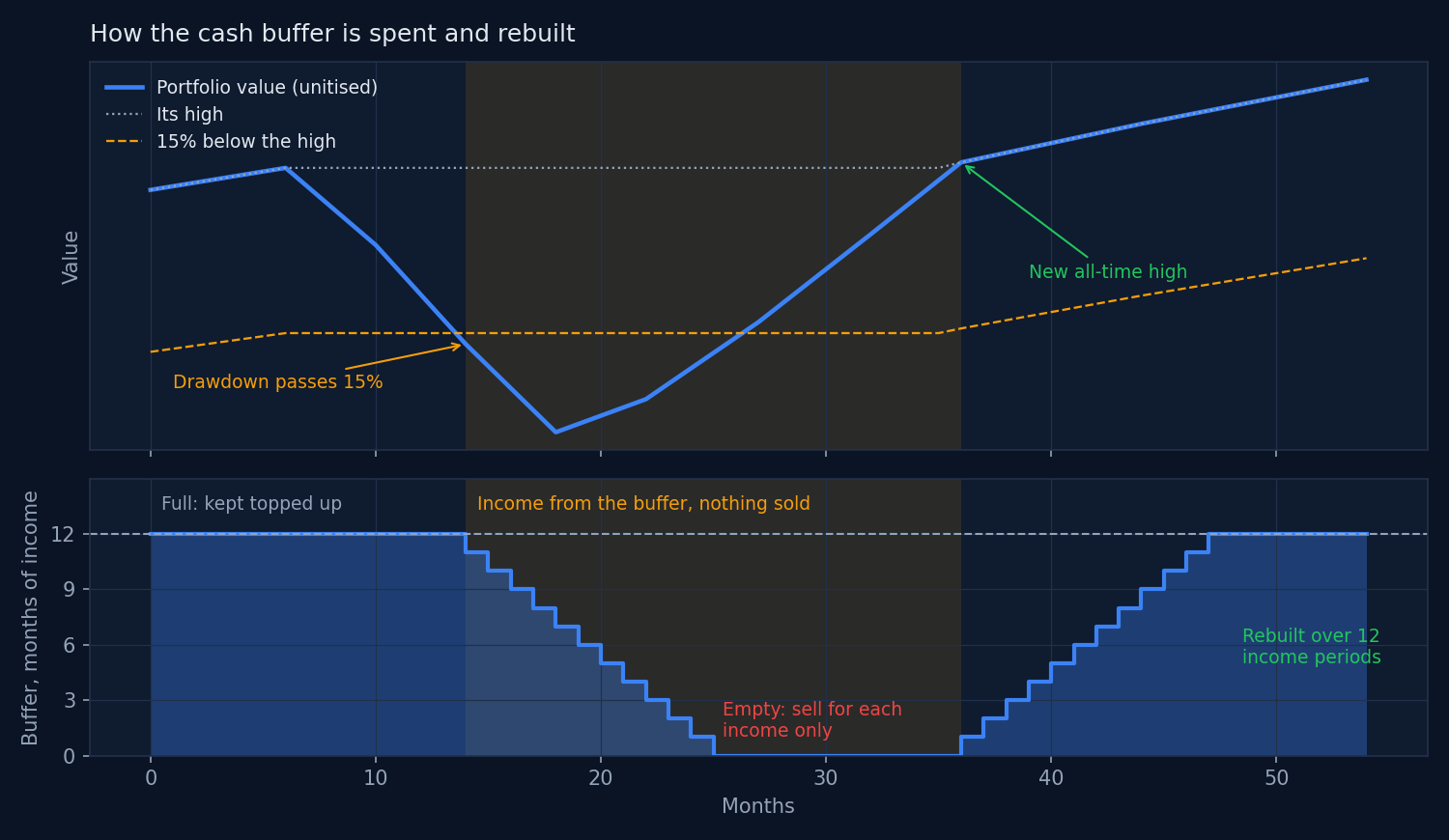
So a 12-month buffer that starts empty builds up over a year. With "Take income from the buffer instead of selling" off, a drawdown does not pause the rebuild. Rebuilding over one period fills it at once. Spare cash already in the accounts (dividends, say) counts in full: it sells nothing, so it is not held back by this limit. A rebalance leaves the buffer alone at the level it has reached, so it neither invests it nor sells to fill it. The Trades tab and the email show the buffer before and after the trades against its target.
A cash buffer account
In drawdown, the cash buffer can sit in one chosen GIA instead of wherever the income sales raised it: each income date the income is withdrawn from that account, and it is refilled from the others.
The refill follows the withdrawal order:
- Spare cash moves to the buffer account first: every GIA's cash above its reserve (dividends included), and with the ISA and SIPP option theirs too.
- Then holdings are sold, within the rebuild limit, and the proceeds move across.
The Trades tab and the email list what to sell, what to move and from where, the income to withdraw, and what stays as the buffer. Only a GIA can be the buffer account: moving cash into an ISA or a pension would use its allowance.
Moving ISA and SIPP cash to the buffer
GIA cash always moves to the buffer account; with this option the spare cash and dividends of accessible ISAs and SIPPs move too. Cash taken out of an ISA leaves it for good, and from a SIPP it is a taxable pension withdrawal.
Accounts that cannot be drawn from yet (a pension before its access age, a Lifetime ISA before 60) are never touched. Without the option an ISA's or SIPP's cash is still used when the walk reaches that account to sell for the income, as it would be without a buffer account.
Last updated 2026-10-20.