What is a bond?
Start here if bonds are new to you. This page explains the basic idea. Bond concepts then explains how bonds are priced and what the figures mean, and the pages after that cover the kinds of bond Alfolio supports.
What is a bond?
A bond is a loan you make to a government or a company. In return they pay you interest at a fixed rate, usually once or twice a year, and pay back the amount you lent on a set date.
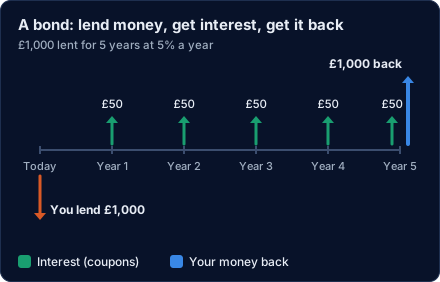
A few words come up again and again:
- Face value (for gilts, nominal): the amount that will be paid back at the end. £1,000 of face value means £1,000 comes back.
- Coupon: the interest, as a yearly percentage of the face value. A 5% coupon on £1,000 pays £50 a year.
- Maturity: the date the face value is paid back and the bond ends.
You do not have to keep a bond until it matures. Bonds can be bought and sold on the market at any time, at whatever price buyers will pay that day. Prices are quoted per £100 of face value, so a price of 97 means £100 of face value costs £97. Why that price is rarely exactly £100 is explained in bond concepts.
Kinds of bond
Bonds differ mainly in who borrows the money, and in whether the payments are fixed or rise with inflation.
- Government bonds are loans to a government. UK government bonds are called gilts; US government bonds are called Treasuries. A government borrowing in its own currency is very unlikely to fail to pay, so these are treated as the safest bonds, and usually pay the least.
- Index-linked bonds raise their coupons and repayment in line with inflation, so they protect what your money will buy. The UK version is the index-linked gilt.
- Corporate bonds are loans to companies. They usually pay more than government bonds, because a company can fail and not pay you back in full.
- Bond funds and bond ETFs hold many bonds at once. They never mature, so they behave differently from a single bond: see bond funds.
In Alfolio:
- Individual UK gilts, both conventional and index-linked, are fully supported: each has a page with its cashflows projected to maturity, and they can be combined in the bond ladder builder.
- Bond funds and bond ETFs are shown like other funds, with the yield and duration reported by our data provider.
- Corporate bonds and other countries' government bonds are not supported yet.
Last updated 2026-10-05.