Rebalancing and trading
The Rebalancing section says when the mix is checked and how far a holding may stray before it is put back. The Trading section says how small a trade is worth proposing and how holdings are sold.
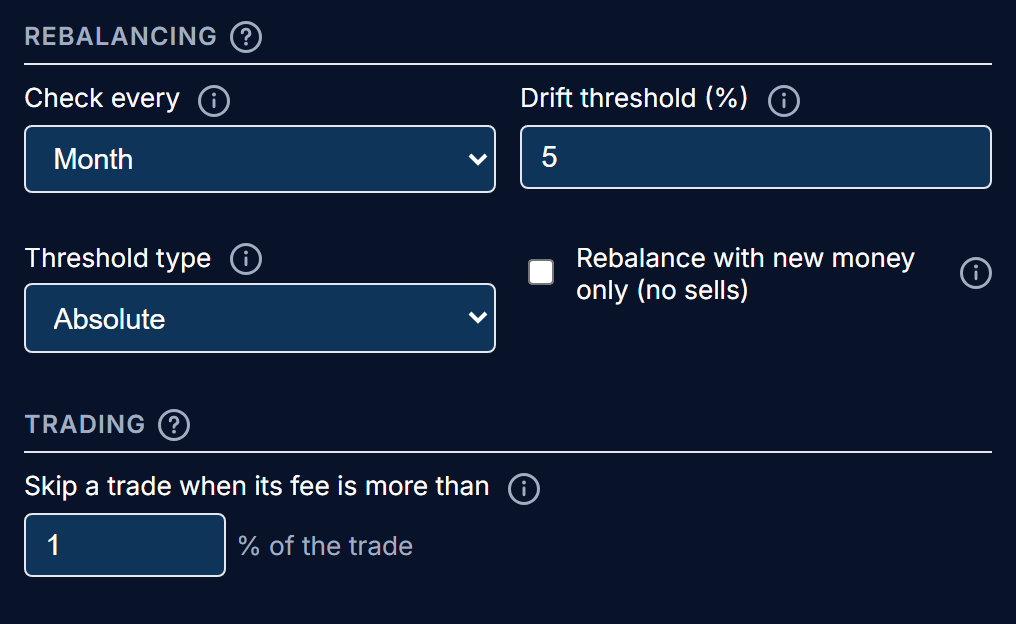
A check only acts on its check date, and only when something is past the band:
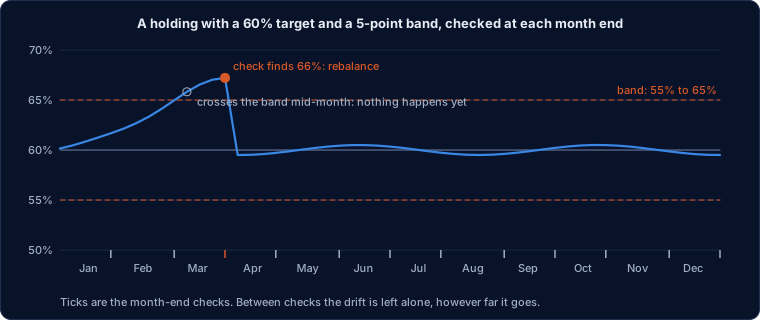
For the general idea of drift and bands, see Rebalancing.
Check frequency
How often every holding and the cash in every account is checked against its target: every trading day, weekly on Mondays, or monthly, quarterly or yearly on the last trading day of the period. Off means only when you click Generate Trades or Rebalance now.
The check runs in the daily check on the check date. Between check dates, drift is left alone, however large; the Trades tab shows when the next check is. A click on Generate Trades checks the drift today, whatever the calendar says.
Drift threshold
How far the whole strategy may move from the model portfolio before a check rebalances: each fund's share of all the strategy's accounts together, and the cash's, against its model weight. Zero rebalances at every check.
It is the household that counts, not each account. If one ISA holds most of a fund and another account holds none, that is not drift as long as the strategy as a whole holds the right amount. Bonds held to maturity (a hold-to-maturity collection) and holdings that are not in the model are shown but not measured. The cash target is the cash to hold plus each account's minimum reserve (in drawdown, plus the dividends kept for the next income).
A gap smaller in pounds than the smallest trade the strategy would place is not counted, since no trade could correct it. That is the smallest trade whose fee fits the dealing cost ceiling, and never less than £10: with a £5 fee and a 1% ceiling, £500.
When it trips, the trades close the household's gaps while moving as little as possible: each account is kept as close as it can be to what it already holds, spare cash buys what the strategy is short of in the account where the cash is, and holdings outside the model are sold first. Each rebalance trade on the Trades tab says why it is there. In accumulation with new money only, only buys. When nothing is past the threshold, the check proposes nothing.
Absolute or relative
Absolute measures drift in percentage points: a 20% target at 25% has drifted 5 points. Relative measures it as a share of the target: the same holding has drifted 25%.
Relative is stricter on small holdings (a 4% target at 5% has drifted 25%) and looser on large ones. See ways to rebalance for how the two kinds of band behave over time.
New money only
In accumulation, a check only buys, from the cash above the reserve and the cash to hold, so your contributions bring the lagging funds up to weight without selling the leaders. Untick it to let a check sell overweight holdings too.
This is the default for accumulation. "Rebalance now" offers "Allow sells this time" for a one-off full rebalance without changing the setting. Selling in a dealing account can create a capital gain; Alfolio does not work that out for you (see what is not done).
Hold-to-maturity collections
A collection marked "hold to maturity" on its own page (a bond ladder saved as a collection is marked by default) is never traded by a strategy: its members are not sold for income, drift or rebalancing and not bought either; they leave the portfolio only when a bond is redeemed, and the cash then counts towards the income like any other.
A ladder placed rung by account (2027–32 in one account, 2033–34 in another) would otherwise look overweight in every rung, because each account's slot is split across all the rungs. So the collection is measured against its target across the whole strategy, and the members are left out of each account's drift and balance score. The Trades tab and the connector show the collection's strategy-wide value against its target.
Skip a trade when its fee is more than …
A trade whose dealing fee would be more than this share of its value (1% by default) is left out, except a sale that closes a position. A £60 buy with a £5 fee costs 8% before it has done anything; the cash waits for a bigger trade.
Every trade also has a fixed £10 floor, for investments, income and rebalancing alike. The Trades tab says how many small trades were skipped for this reason.
The fee comes from the account's settings: a fixed amount per trade, a share of the trade (Interactive Brokers UK charges 0.05%, minimum £3), or both. An account with no fee set is shown as "fee not set" rather than free.
Selling methods
When an account has to sell (for an income, a transfer, or a rebalance that allows sells), its selling method says which holdings go first: the most overweight, proportionally across all of them, or the ones showing a loss.
- Sell overweight first. Sell the holdings furthest above target, which moves the account toward its targets as a side effect.
- Sell proportionally. Sell a slice of every holding in proportion to its weight, keeping the mix as it is.
- Sell losers first. Sell the holdings showing a loss before the ones showing a gain. In a dealing account this can reduce the capital gain of the sale, but it is an ordering rule only: Alfolio does not calculate a tax figure for the trades it proposes.
Each account has its own method, set in the Accounts & order list, and each scheduled transfer has one for its source account.
Last updated 2026-10-10.