A portfolio needs a strategy
A portfolio is a mix of investments chosen to give a target return at a level of risk you can live with. That is all it is. It does not know what the money is for, when you will need it, or whether money is going in or coming out. A strategy does: it gives the portfolio a purpose and a place in your life, and the right portfolio follows from it.
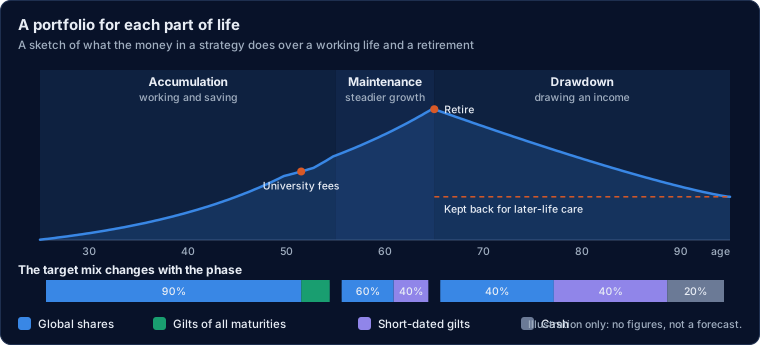
A portfolio is not a strategy
A portfolio answers "what should I hold?". A strategy answers "what is this money for, and when will I need it?". The same 60/40 mix can be too cautious for a 30-year-old saving for retirement and too risky for a family needing a house deposit next year.
The portfolio pages explain how a mix is built: how much return to aim for, how much a fall you can stomach, and how combining assets that move differently smooths the ride. A strategy sits above that. It says:
- What the money is for, and so how long it can stay invested.
- Which way money is moving: paid in, left alone, or taken out.
- Which accounts it lives in, and in what order they are filled and drawn on.
- How the mix should change as the goal comes closer.
What is the money for?
Every goal has a date, a direction and a particular thing that can go wrong. Writing those down usually decides the portfolio more than any forecast does.
| Goal | When the money is needed | Money moving | What matters most |
|---|---|---|---|
| Retirement, while working | In 20 or 30 years | In, every month | Growth; a fall now is a chance to buy cheaper |
| A child's university costs | At 18, over three or four years | In, then out | Not being caught by a fall just before the fees are due |
| A house deposit | In two or three years | In, then all out at once | Knowing the sum will be there |
| An income in retirement | Now, and for the rest of your life | Out, steadily | A reliable income that does not run out, with enough kept back for care in later life |
| A family trust | Over generations | Mostly left to grow, some paid out | Spending less than it earns after inflation, so it lasts |
A short horizon leaves no time to recover from a fall, so a house deposit due in two years belongs mostly in cash and short-dated gilts, whatever the shares might do. A pension 30 years away can ride out several crashes.
The three phases
Most money passes through three phases. In accumulation you are paying in and the pot is growing. In maintenance it is left to grow on its own, usually with a steadier mix. In drawdown (also called decumulation) it is paying you an income.
- Accumulation. Working, saving and investing regularly. Time is on your side and every contribution buys at that month's price, so the mix can lean heavily on shares. Falls hurt on paper, but they also mean new money buys more.
- Maintenance. The pot is built and not yet needed, such as the years before retirement, or a fund that has reached its size. The aim shifts towards keeping what has been made, so the mix usually gets steadier.
- Drawdown. The pot pays an income. Now a fall forces you to sell more units to raise the same income, so cash and bonds earn their place as a buffer you can draw on while shares recover.
One household often has money in several phases at once: a child's Junior ISA accumulating while the parents draw on their pensions.
The portfolio follows the phase
As a strategy moves from accumulation to drawdown, its target mix usually moves from mostly shares towards bonds and cash: a lower expected return in exchange for a smaller swing in value when it matters most.
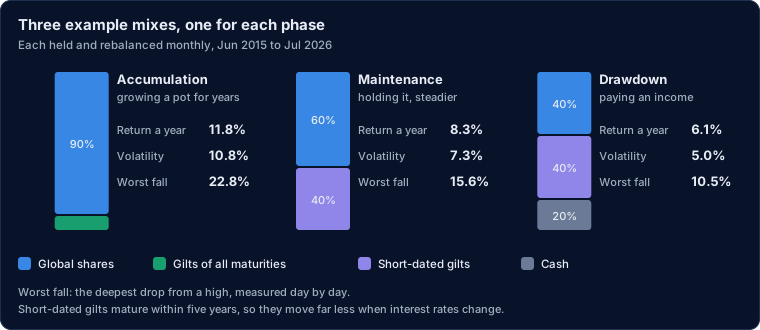
Over Jun 2015 to Jul 2026 each step gave up some return for a smoother ride: 11.8%, 8.3% and 6.1% a year, with volatility of 10.8%, 7.3% and 5.0%, and a worst fall, measured day by day, of 22.8%, 15.6% and 10.5%. All three worst falls were the five weeks of February and March 2020.
The kind of bond matters as much as the amount. The steadier mixes hold short-dated gilts, which mature within five years and move little when interest rates change. A fund of gilts of all maturities fell 35% between 2020 and 2022 as rates rose, more than shares fell in 2020, so it would not have steadied anything. Duration explains why longer bonds move more, and diversification why assets that usually move apart sometimes fall together.
These mixes are illustrations, not recommendations. They show how a mix tends to change from one phase to the next, over one stretch of history. None is a portfolio chosen to suit your circumstances, and the past figures are not a forecast. Alfolio does not give financial advice.
The right mix for each phase depends on you, and the optimizer can help you explore one.
Why the order of returns matters when drawing an income
While you are only investing, the order in which good and bad years arrive makes no difference to where you end up. Once you are taking an income it matters a great deal: a fall early in retirement forces you to sell more at low prices, and those units are not there for the recovery.
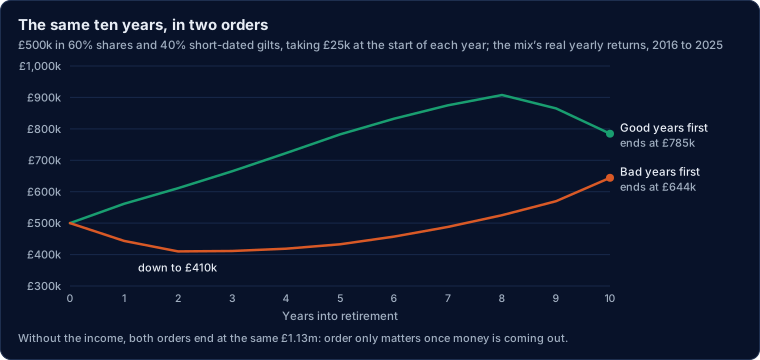
The example takes the ten calendar years 2016 to 2025 of the maintenance mix above, from 18.2% in the best year to −6.6% in the worst, and plays them in two orders while taking £25,000 a year from £500,000. With the good years first the pot ends at £785k. With the bad years first it drops to £410k and ends at £644k, although the years are exactly the same. Leave the income out and both orders end at £1.13m. A mix with more in shares, or a decade with a deeper fall, widens the gap.
This is the main reason a drawdown strategy keeps a cash buffer: an income can be paid from cash for a while rather than from selling shares after a fall. See cash to hold.
One strategy for each goal
In Alfolio a strategy is one goal: a target portfolio, the accounts that serve it, a phase, and the rules for money in and out. Give each goal its own strategy and its own accounts; an account belongs to one strategy at a time.
Changing phase keeps the accounts and the settings, so a strategy can follow its goal through life. Alfolio does not change the mix for you as a date approaches: when it is time to become more cautious, pick a steadier portfolio under Target Allocation (Portfolio) on the strategy page, then use Rebalance now for the trades to get there. In accumulation with new money only on, which buys only, tick "Allow sells this time" if the move means selling. Strategy examples shows how the goals above translate into settings, and Strategies explains the page itself.
Last updated 2026-10-13.