Money out
The Money out section appears in the drawdown phase. It says how much income to take, how often, and where it comes from.
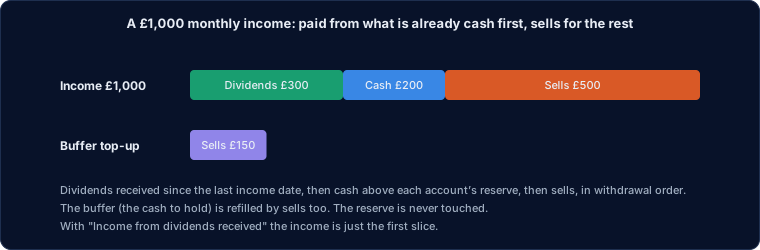
An income is paid from what is already cash first, and holdings are sold only for the rest:
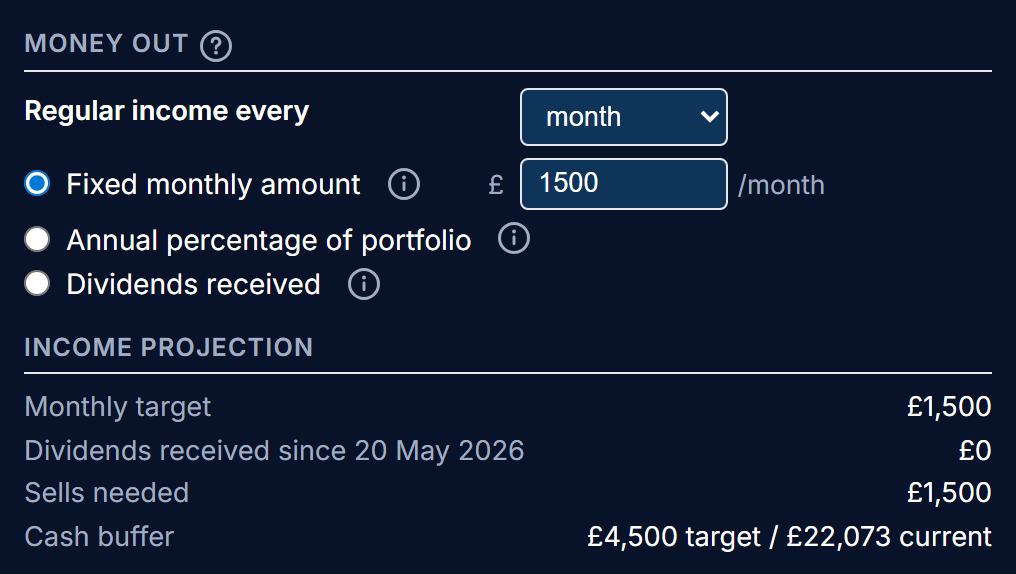
Fixed income
Take a fixed amount of cash each period. It is paid from dividends received and cash above the reserve in the accessible accounts first; holdings are sold only for the rest.
Choose the amount and the period (month, quarter or year). The income is due once per calendar period, counted from the last date you marked it drawn. If several periods pass without the income being marked drawn, only the current period's income is proposed; the page says how many periods have passed, and you can run Generate Trades for each one you want to draw.
What is sold, and from which account, follows the withdrawal order and each account's selling method. The sells also top up the cash to hold when it is below target.
Percentage income
Take a percentage of the whole strategy's value each year, divided across the income periods. The amount rises and falls with the portfolio.
The value used is every account's holdings plus cash on the day the income is due, pensions included. To leave a pension out, leave it out of the strategy. The page shows the rate the accounts that can be drawn from now actually bear. Four per cent a year drawn monthly is a third of a per cent of that value each month. Everything else works as for a fixed income.
Income from dividends received
The income is the dividends and interest credited to the accessible accounts since the last income date, read from the account transactions, as far as they are still held as cash. Nothing is sold to reach a target, so the income varies with what the funds pay.
The Income Projection shows the figure that will be paid at the next income date. A dividend that has since been reinvested (by a check, or by your broker) or taken out is no longer cash, so it is not paid out again: the projection shows what was received and how much of it is still in cash. Dividends credited on the last income date itself were paid out with that income and are not counted again. When no income has been drawn yet, dividends are counted from the day the strategy was created.
Choose the scope: accessible accounts only or replicate the full portfolio yield.
Accessible accounts only
Pay out only the dividends received in the accounts you can withdraw from. Dividends in accounts excluded from withdrawals (a pension before retirement age, say) stay there and are reinvested at the next check.
Replicate the full portfolio yield
Pay out the dividends received in every account, including the ones excluded from withdrawals: the accessible accounts sell the cash equivalent of the locked accounts' dividends, and the locked accounts reinvest their own. Your holdings stay the same overall; the income is the whole portfolio's yield.
Dividends received count towards the income
With a fixed or percentage income, the dividends credited to the accessible accounts since the last income date, as far as they are still held as cash, always count towards the income, so sales only cover the rest.
They are the dividends actually received, read from the account transactions, not an estimate from the funds' yields. A dividend already reinvested or taken out is not cash any more and cannot be paid out twice, and money paid in since the last income date (a contribution, a transfer in) is taken to be in the account before any dividend is, so it is never counted as one. The figures add up as: dividends received = still in cash in the accessible accounts (counted) + still in cash in locked accounts (counted only when replicating the full yield) + reinvested or taken out. The Trades tab explains each sale the same way: the income, plus the cash buffer and reserve to keep, less the cash already there, of which the counted dividends are a part (they are not taken off twice). A selling account that starts below its reserve is refilled first, and the sale also covers its own dealing fees, so both are added to it. The sell legs then differ from that figure only by rounding to whole units, and the tab says how much of the cash buffer was reached.
Last updated 2026-10-10.